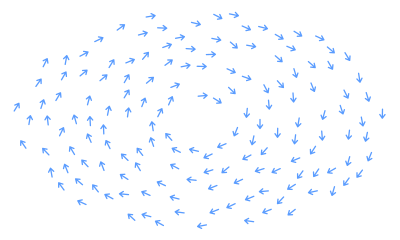
Active matter refers to many-body systems made of living or otherwise self-driven agents. Such systems often show striking collective behaviour, including self-organisation and spontaneous structure formation, quite unlike ordinary passive matter. Active matter typically draws on an external fuel reservoir, such as food, which lets it locally circumvent the second law of thermodynamics by reducing its own entropy. The global second law of course still holds: the corresponding entropy increase appears in the fuel reservoir and the environment.
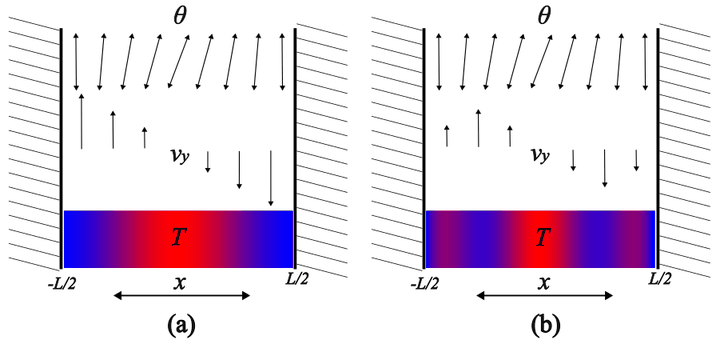
With Jay Armas and Ruben Lier, I have developed a new hydrodynamic framework for active matter that consistently includes fuel reservoirs and the environment. It lets us study temperature and energy fluctuations in active systems, which earlier hydrodynamic models could not capture, and predicts the distinctive temperature profile of a confined active nematic.
Papers
-
Temperature of an active nematic
Active matter, such as bacterial suspensions or the filaments inside cells, is made of units that burn fuel to move on their own. We ask what the local temperature of such a system looks like, using a hydrodynamic framework that tracks the exchange of energy with the environment. In a uniform active nematic, a liquid crystal of such units, activity leaves the temperature fluctuations unchanged. But when the nematic is confined and starts to flow spontaneously, local shearing and twisting produce a distinctive uneven temperature profile: a thermal fingerprint of activity.
-
Hydrodynamics of thermal active matter
Living things stay ordered by burning fuel and shedding the excess heat into their surroundings. Active matter, from bacterial colonies to the filaments inside cells, works the same way, yet theories of its flow usually leave out temperature, since fuel keeps pumping in energy. We model active matter as an open system that burns fuel and loses heat to its environment, settling at a steady temperature. The resulting theory includes temperature and random fluctuations, traces how active matter breaks the rules of thermal equilibrium to one source, and predicts activity-driven phase transitions.