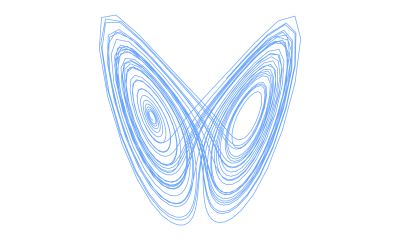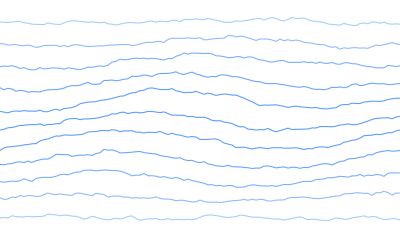
The ordinary theory of hydrodynamics, while extremely successful, does not account for the inherently random nature of our universe, both quantum and thermal. When carefully accounted for, these effects can change the qualitative predictions of hydrodynamics for non-equilibrium phenomena. They are particularly important in situations that are naturally out of equilibrium, such as critical phenomena, active and biological matter, and astrophysical processes.
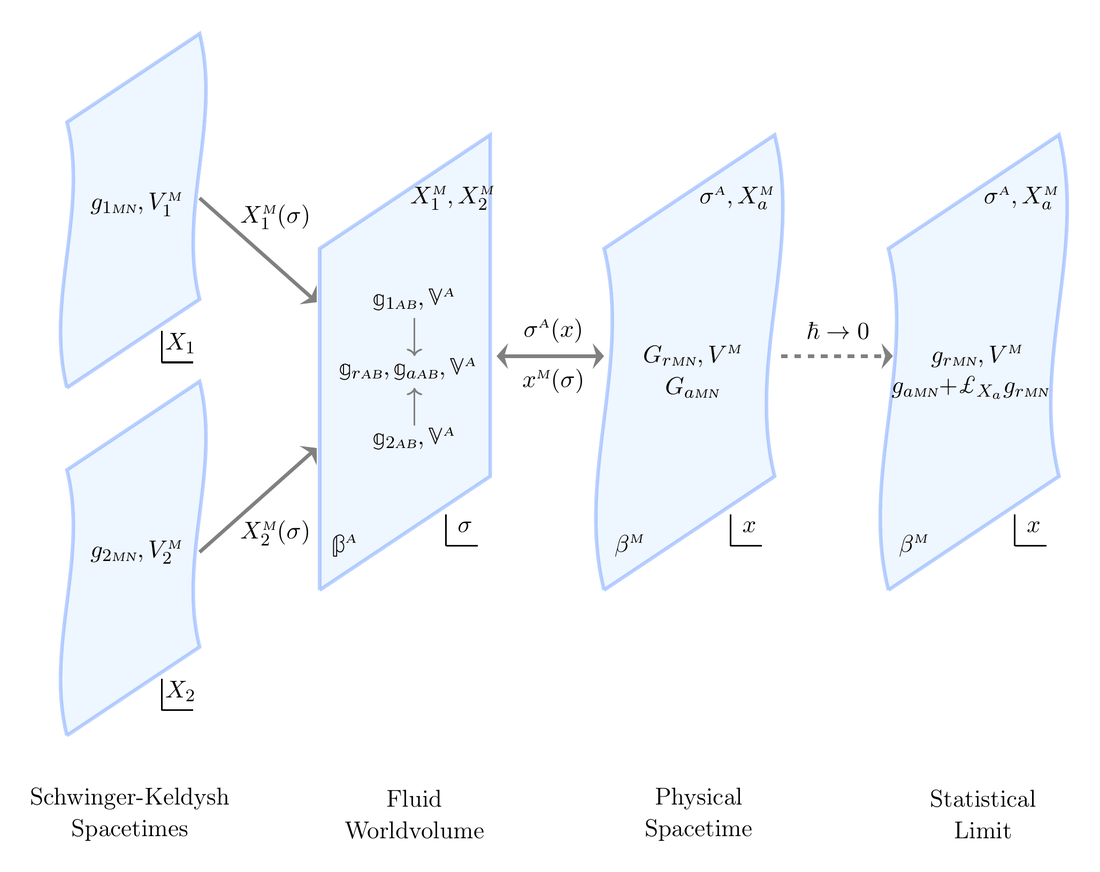
Schwinger–Keldysh hydrodynamics is a recently developed framework that systematically builds random, stochastic processes into the universal theory of hydrodynamics. My work has developed it for relativistic, non-relativistic and boost-agnostic fluids, shown that fluctuations carry information that classical hydrodynamics cannot see, extended the framework to quantum fluctuations, and derived it from a solvable model of quantum chaos, the SYK lattice.
Watch a talk on Schwinger–Keldysh hydrodynamics on YouTube.
Papers
-
Hydrodynamics and effective field theories of relativistic fluids
-
All-order fluctuating hydrodynamics of the SYK lattice
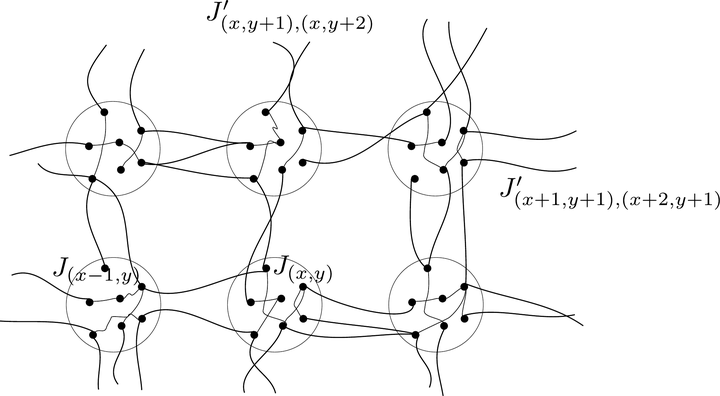
Hydrodynamics describes how energy and charge flow in almost any system at long distances and late times, but deriving it from the underlying microscopic physics is notoriously hard, especially when the particles interact strongly. We do this for the SYK lattice, a solvable model of strongly interacting quantum particles that has become a playground for quantum chaos. We show how hydrodynamics, random fluctuations included, emerges from the model at low energies, and pin down every ingredient of the theory, including the infinite series of corrections that are usually neglected.
-
Quantum fluctuations in hydrodynamics and quantum long-time tails
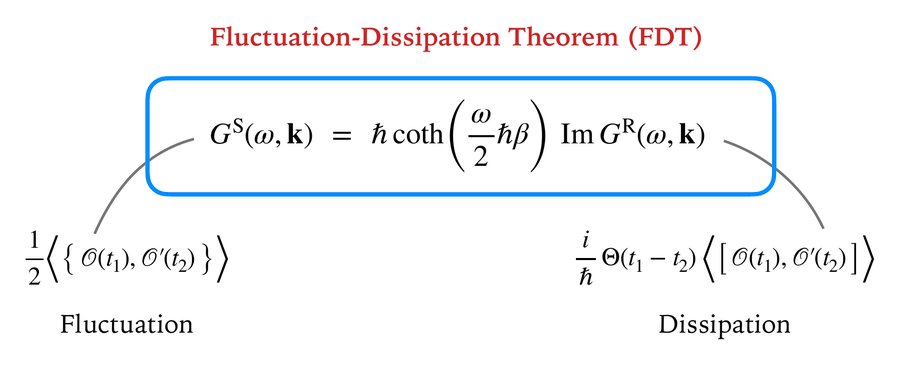
Wherever there is dissipation there are also fluctuations, as the fluctuation-dissipation theorem states. Hydrodynamics usually includes them as classical random noise, which fails when quantum effects are as fast as the system’s own microscopic processes, as in many strongly interacting systems. I construct a quantum version of the effective theory of diffusion that obeys the theorem in full. One surprise is that its noise is necessarily non-Gaussian. I also compute how quantum effects modify the long-time tails, the slow fading of disturbances in a fluid, to all orders in Planck’s constant.
-
Schwinger-Keldysh effective field theory for stable and causal relativistic hydrodynamics
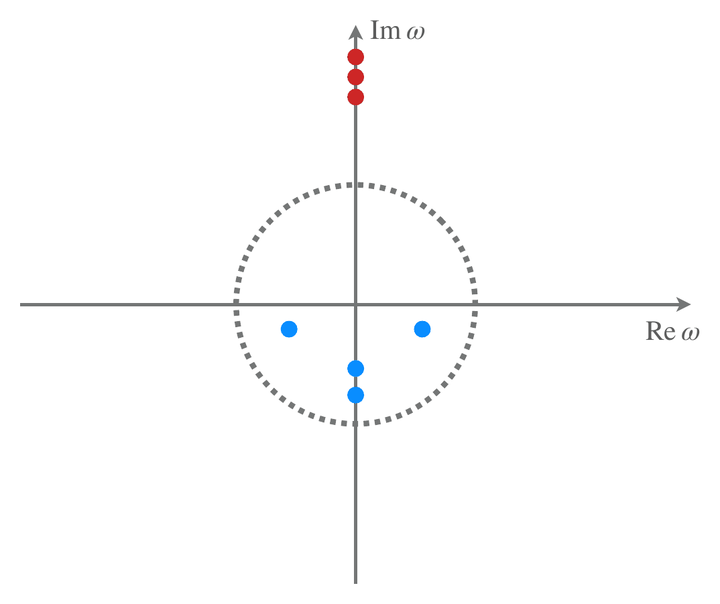
Relativistic hydrodynamics describes fluids where relativity matters, like the plasma made in collisions of heavy nuclei. Its textbook version has a notorious flaw: seen by a moving observer, it predicts signals faster than light and runaway instabilities. Known fixes repair the equations but leave out random thermal fluctuations, which matter near critical points. We build theories of diffusion and of full relativistic hydrodynamics that include them, are stable and causal by design, and respect the link between fluctuations and dissipation, and show why one popular fix doesn’t carry over.
-
Hydrodynamic effective field theory and the analyticity of hydrostatic correlators
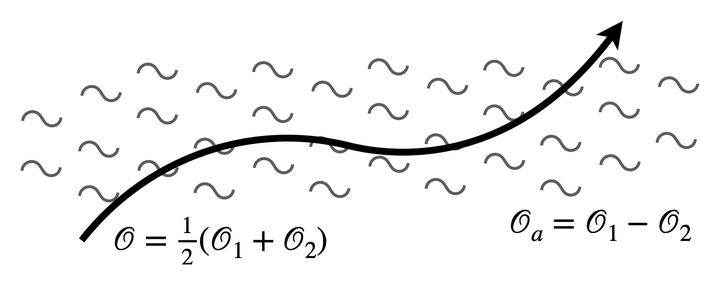
Hydrodynamics usually ignores the random thermal fluctuations present in every fluid, yet these interact and leave long-lasting imprints, such as long-time tails. In equilibrium, however, a fluid’s static response should still die off quickly with distance, a sign of thermal screening. We test this in the effective field theory of fluctuating hydrodynamics, computing the leading corrections for diffusing charge. The corrections do produce long-range effects in time, but a symmetry encoding the fluctuation-dissipation theorem cancels them in the static response, as equilibrium requires.
-
Effective field theory for hydrodynamics without boosts
Most theories of fluids assume that physics looks the same to an observer moving at constant speed, a symmetry called boost invariance. Many systems break it, such as fluids flowing through a medium, electrons in some quantum materials, or very cold liquid helium-3. We build the effective field theory of hydrodynamics without boost symmetry, including random fluctuations, and find 29 independent transport coefficients at first order. Sound then travels at different speeds with and against the flow. The framework treats relativistic, non-relativistic and exotic fluids alike.
-
Late Time Correlations in Hydrodynamics: Beyond Constitutive Relations
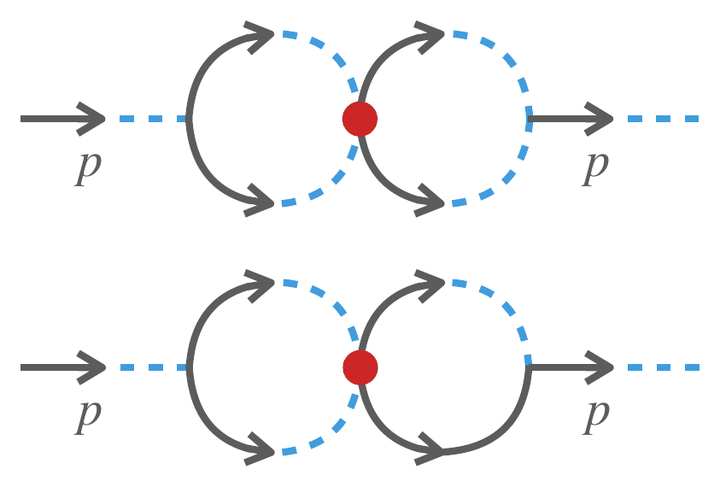
Hydrodynamics is often called universal: at long distances and late times, a fluid’s behaviour is supposedly fixed by a handful of numbers, such as its viscosity and conductivity. Random thermal fluctuations complicate this, and are usually modelled by the simplest noise that reproduces the classical equations. Using the effective field theory of fluctuating hydrodynamics, we show that this choice is not unique: new “stochastic transport coefficients”, invisible in the classical equations, still shape late-time correlations. Viscosity and its cousins do not tell the whole story.
-
Effective field theory for non-relativistic hydrodynamics
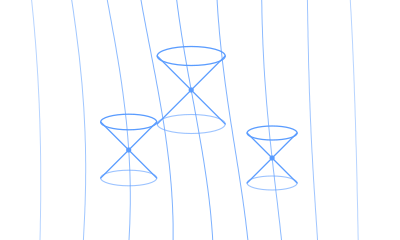
Everyday fluids such as water and air move far slower than light and obey non-relativistic physics. A modern effective field theory of hydrodynamics, which also accounts for random thermal fluctuations, existed for relativistic fluids, but not for these ordinary ones. I construct it using a geometric trick: a non-relativistic fluid can be viewed as a relativistic one in a spacetime with one extra dimension, along a special lightlike direction. The relativistic tools then carry over, and I use them to work out how fluctuations of energy, momentum and density interact.
Talks
Schwinger-Keldysh effective field theory
-
Review talk
Holography, Gauge Theories and Black Holes Workshop, University of Southampton, UK
Schwinger-Keldysh hydrodynamics of the SYK lattice
-
Conference talk
Contours 2026: EFTs Meet the Schwinger-Keldysh Formalism, University of Cambridge, UK
-
Conference talk
Correlated Quantum Systems Workshop, Institut Pascal, Université Paris-Saclay, France
-
University of Oxford, UK
Quantum fluctuations in Schwinger-Keldysh hydrodynamics
-
High-TheQ Seminar, Ghent University, Belgium
-
Conference talk
Indian Strings Meeting, IIT Bhubaneswar, India
Hydrostatic compatibility of Schwinger-Keldysh effective field theories
-
IsoQuant Seminar, University of Heidelberg, Germany
-
Conference talk
Foundations and Applications of Relativistic Hydrodynamics Workshop, GGI Florence, Italy
Causal and stable formulation of relativistic Schwinger-Keldysh hydrodynamics
-
University of Oviedo, Spain
-
University of Bristol, UK
-
Panel discussion, “Causal stable relativistic hydrodynamics,” HoloTube Seminar (online)
Stochastic transport coefficients in Schwinger-Keldysh hydrodynamics
-
IIT Madras, India (online)
-
Conference talk
Hydrodynamics at All Scales Workshop, NORDITA Stockholm, Sweden
-
Center for Nuclear Theory, Stony Brook University, USA (online)
-
University of Amsterdam, Netherlands
-
NORDITA Stockholm, Sweden (online)
-
Durham University, UK (online)
-
University of Edinburgh, UK (online)
-
Autonomous University of Madrid, Spain (online)
Non-relativistic Schwinger-Keldysh hydrodynamics