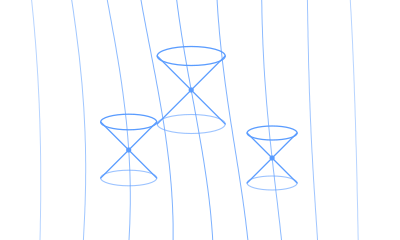
Relativistic hydrodynamics describes matter that moves close to the speed of light or carries enormous energy densities: the quark–gluon plasma created in heavy-ion collisions, and the plasmas around neutron stars and black holes. A relativistic fluid must respect causality – no signal can travel faster than light – and this turns out to be a subtle requirement for theories that include dissipation.
My work in this direction covers stable and causal formulations of relativistic hydrodynamics, fluids that carry spin, and relativistic magnetohydrodynamics for astrophysical plasmas. With Pavel Kovtun, Jorge Noronha and Amos Yarom, I am writing a review of hydrodynamics and effective field theories of relativistic fluids for Reviews of Modern Physics.
Papers
-
Hydrodynamics and effective field theories of relativistic fluids
-
Thermodynamics of ideal spin fluids and pseudo-gauge ambiguity
Collisions of heavy nuclei create a droplet of quark-gluon plasma that swirls so strongly it lines up the spins of the particles it produces. Describing it needs spin hydrodynamics, but how angular momentum splits between the flow and the particles’ spin is not unique: different “pseudo-gauge” choices give different answers, and those that come out of microscopic models break the usual rules of thermodynamics. We find a family of choices in which these rules hold, measure how much the spin’s thermodynamic properties depend on the choice, and work them out for free fermions and scalar fields.
-
Resistive relativistic magnetohydrodynamics without Ampère’s law
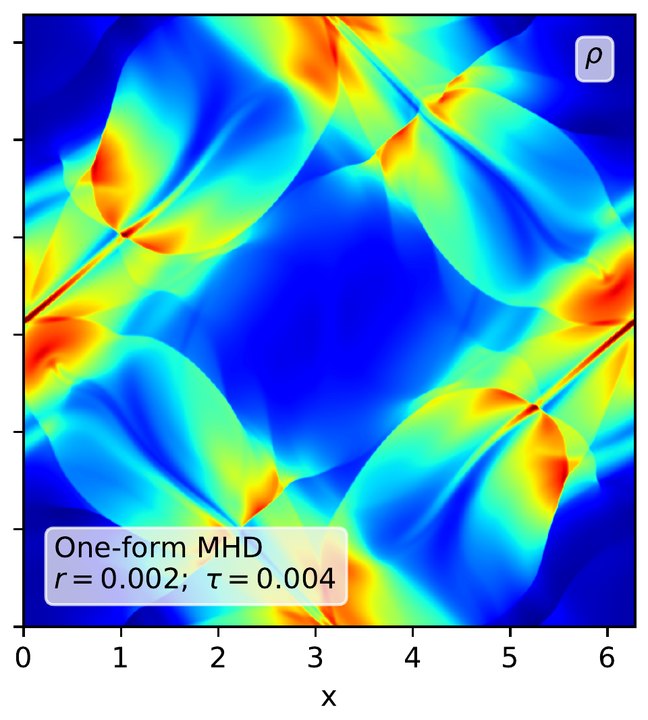
Magnetic reconnection, where magnetic field lines in a plasma break and rejoin, powers flares and particle acceleration in high-energy astrophysics. It relies on the plasma’s small electrical resistance, which is hard to simulate: in the traditional description, Ampère’s law makes the equations “stiff” and forces tiny time steps. We drop Ampère’s law altogether, using a formulation of magnetohydrodynamics based on a higher-form symmetry in which resistivity acts like a magnetic viscosity, and build a causal numerical scheme that handles strong shocks moving near the speed of light.
-
Schwinger-Keldysh effective field theory for stable and causal relativistic hydrodynamics
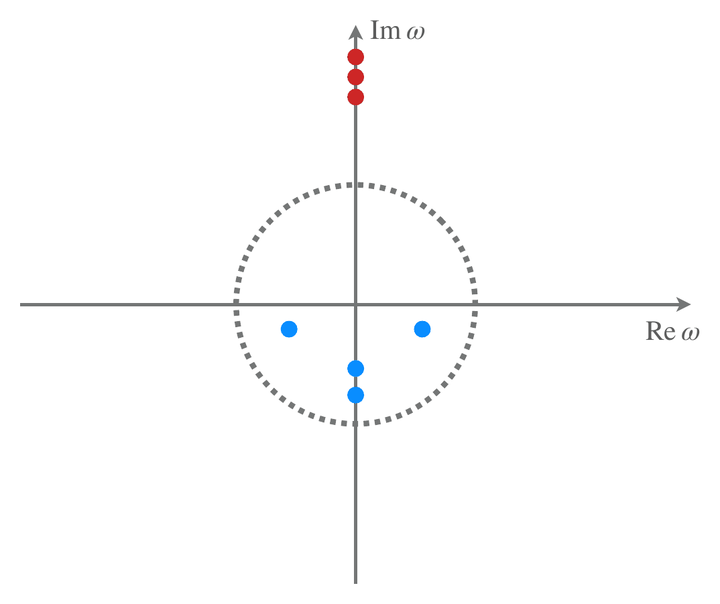
Relativistic hydrodynamics describes fluids where relativity matters, like the plasma made in collisions of heavy nuclei. Its textbook version has a notorious flaw: seen by a moving observer, it predicts signals faster than light and runaway instabilities. Known fixes repair the equations but leave out random thermal fluctuations, which matter near critical points. We build theories of diffusion and of full relativistic hydrodynamics that include them, are stable and causal by design, and respect the link between fluctuations and dissipation, and show why one popular fix doesn’t carry over.
-
One-form superfluids & magnetohydrodynamics
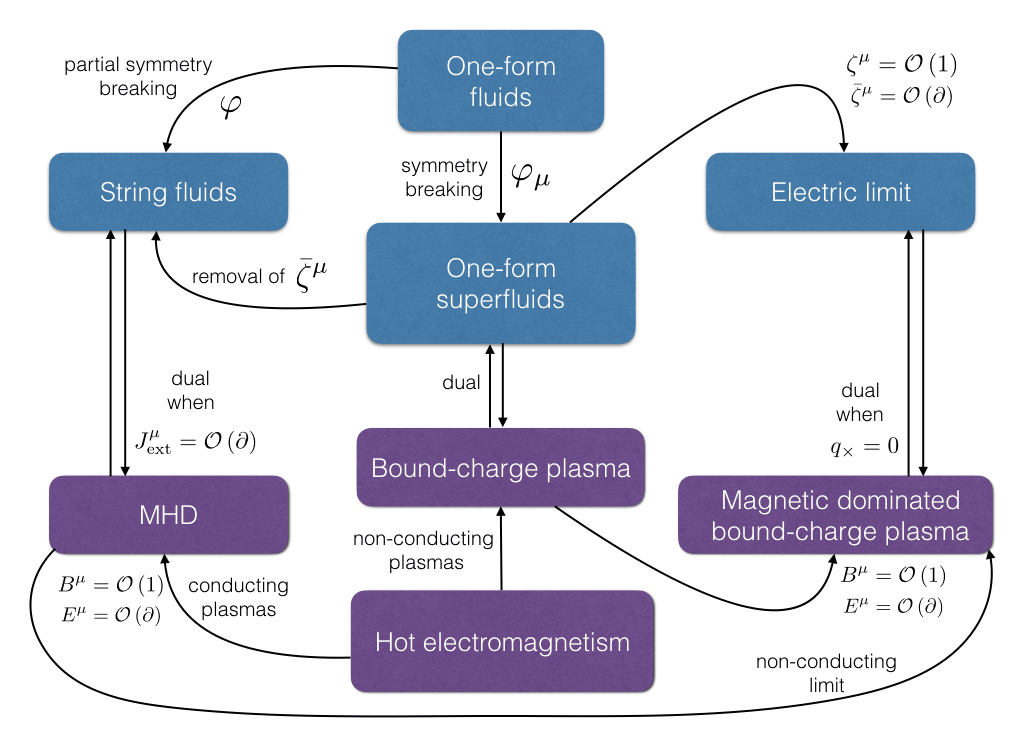
Magnetohydrodynamics, the theory of electrically conducting plasmas, describes everything from accretion disks around black holes to fusion reactors. We reformulate it using generalised symmetries, in which the fact that magnetic field lines never end becomes a symmetry, and show that magnetohydrodynamics is a “one-form superfluid” in which this symmetry is partly broken. Breaking it completely describes plasmas without free charges that can still be polarised, such as a neutral gas bathed in light, for which we build the first hydrodynamic theory. We also map out their equilibrium states.
-
Magnetohydrodynamics as superfluidity
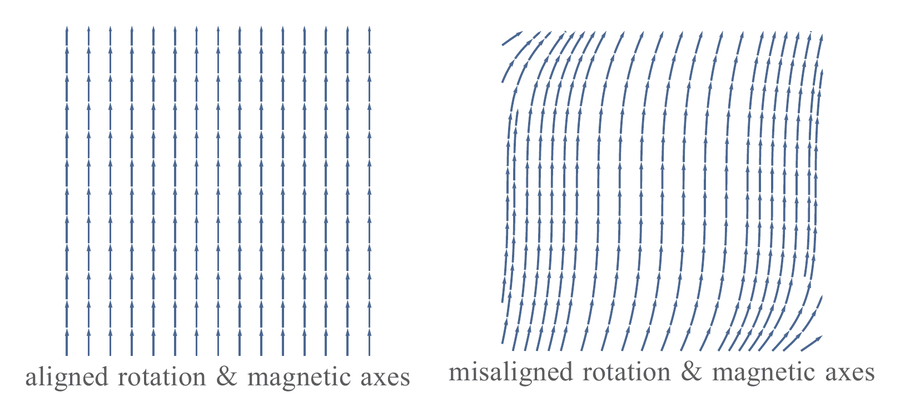
Magnetohydrodynamics describes how plasmas and magnetic fields move together, in stars and galaxies as well as in fusion experiments. We show that it can be recast as a new kind of superfluid. Magnetic field lines never end, since there are no magnetic monopoles, and this can be viewed as a “one-form” symmetry; in a plasma the symmetry is spontaneously broken, with a magnetic scalar potential as its Goldstone mode. This writes magnetohydrodynamics purely as conservation equations, better suited to simulations, and settles how its equilibrium states should be defined.
Talks
Ideal spin fluids and pseudo-gauge ambiguity
-
IISER Bhopal, India
-
Saha Institute of Nuclear Physics, Kolkata, India
-
IIT Kharagpur, India
Causal and stable formulation of relativistic Schwinger-Keldysh hydrodynamics
-
University of Oviedo, Spain
-
University of Bristol, UK
-
Panel discussion, “Causal stable relativistic hydrodynamics,” HoloTube Seminar (online)
Generalised global symmetries and magnetohydrodynamics
-
Université Libre de Bruxelles, Belgium
-
Autonomous University of Madrid, Spain
-
University of Barcelona, Spain
-
Utrecht University, Netherlands
-
École Polytechnique, France
-
Perimeter Institute for Theoretical Physics, Canada
-
University of British Columbia, Canada
-
Harish-Chandra Research Institute, Allahabad, India
-
IISER Bhopal, India
-
Tata Institute of Fundamental Research, Mumbai, India
-
IISER Pune, India