A superfluid flows without friction. Its hydrodynamics couples the usual fluid variables to a Goldstone mode of a spontaneously broken symmetry. My work includes the theory of non-Abelian superfluids, the hydrodynamics of superfluid surfaces, and Galilean superfluids. I have also studied anomalies – quantum effects that break classical symmetries – and the distinctive imprint they leave on transport, including in charged fluids at higher orders in derivatives.
The same ideas reappear in my later work on one-form superfluids, which describe magnetohydrodynamics, and on dipole superfluids in fractonic matter.
Papers
-
Dipole superfluid hydrodynamics
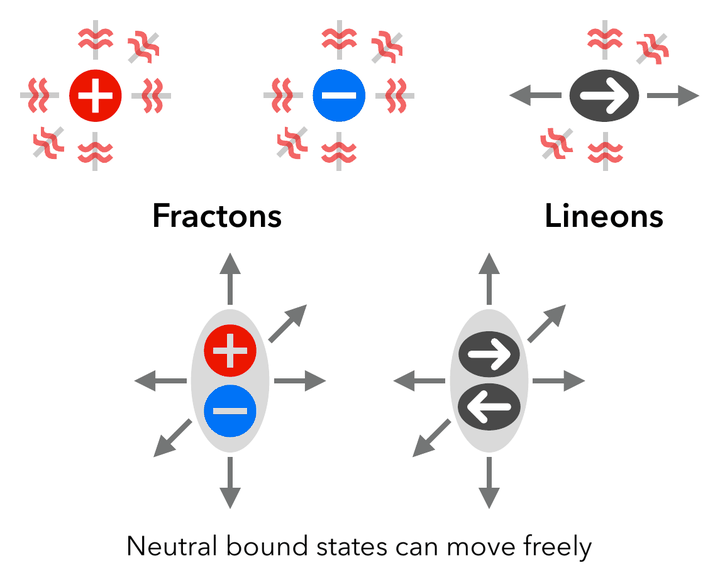
Fractons, exotic excitations that cannot move on their own, can arise in systems that conserve not just charge but also its centre, the dipole moment. This is expected in two-dimensional elastic materials, vortices in superfluid helium and atoms in tilted optical lattices. We develop the theory of how they flow at finite temperature, showing that they only transport charge if the dipole symmetry is spontaneously broken, making them “dipole superfluids”. Their ripples are unusual: sideways disturbances fade far more slowly than in ordinary fluids, and sound behaves like spin waves in a magnet.
-
One-form superfluids & magnetohydrodynamics
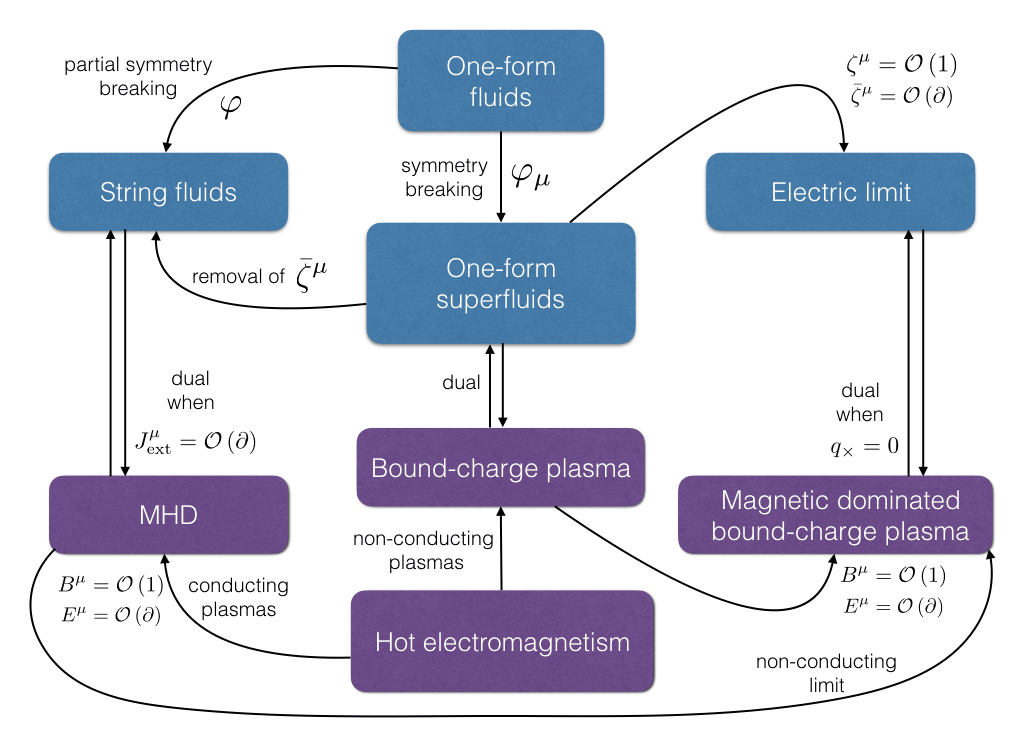
Magnetohydrodynamics, the theory of electrically conducting plasmas, describes everything from accretion disks around black holes to fusion reactors. We reformulate it using generalised symmetries, in which the fact that magnetic field lines never end becomes a symmetry, and show that magnetohydrodynamics is a “one-form superfluid” in which this symmetry is partly broken. Breaking it completely describes plasmas without free charges that can still be polarised, such as a neutral gas bathed in light, for which we build the first hydrodynamic theory. We also map out their equilibrium states.
-
On the surface of superfluids
When two phases of a fluid coexist, such as a liquid and its vapour, they are separated by a surface with physics of its own. Building on earlier work on ordinary fluids, we study the surfaces of superfluids, describing a superfluid bubble in equilibrium with an effective action. We find new surface effects, some of which break mirror symmetry, all fixed by the properties of the superfluid inside. Ripples on the surface reveal new modes: a sound-like surface wave and, when mirror symmetry is broken, a surface wave that travels in only one direction.
-
First Order Galilean Superfluid Dynamics
Superfluids, first seen in liquid helium in 1938, flow without friction and form vortices when rotated. We work out the general theory of how non-relativistic superfluids flow and dissipate at first order in gradients, including effects that break mirror symmetry or come from quantum anomalies. To do so, we construct “null superfluids”: relativistic superfluids in one extra dimension that are exactly equivalent to non-relativistic ones, so that the powerful tools of relativistic hydrodynamics can be applied.
-
Theory of non-Abelian superfluid dynamics
In a superfluid, a symmetry is spontaneously broken, giving rise to massless “Goldstone” modes that allow flow without friction. In helium-4 the broken symmetry is simple, but in helium-3 and other systems more intricate, non-Abelian symmetries can break. I develop the hydrodynamics of superfluids with any such broken symmetry, along with the constraints imposed by the second law of thermodynamics. Remarkably, the second law alone yields the Josephson equation, which governs how the Goldstone modes evolve. I also propose a new way to classify how such fluids transport energy and charge.
-
Galilean Anomalies and Their Effect on Hydrodynamics
Quantum anomalies are symmetries of a classical theory that are broken by quantum effects. In relativistic fluids, such as the quark-gluon plasma, they make currents flow along magnetic fields and rotation axes. I study anomalies in non-relativistic theories by viewing them as relativistic theories in one extra dimension, now also allowing for spin and the torsion of spacetime. As in the relativistic case, they only occur in even dimensions, and they leave Galilean boosts untouched. I also work out how they modify the flow of non-relativistic fluids.
-
Higher Derivative Corrections to Charged Fluids in 2n Dimensions
Quantum anomalies, symmetries broken by quantum effects, leave distinctive mirror-asymmetric imprints on how charged fluids flow, as first discovered through holography. In four spacetime dimensions, the second law of thermodynamics fixes many of these effects in terms of the anomaly. We extend this analysis to fluids in any even number of dimensions, one step beyond the leading effect, using the fluid’s equilibrium partition function. Along the way we develop a systematic way to count all the possible terms at any order, and show that a simpler subset suffices to find the constraints.
Talks
Offshell framework of hydrodynamics
-
Durham University, UK (HEP Student Seminar)