Akash Jain

Search

Fractons and dipole symmetry

Phases of matter whose excitations cannot move on their own, and the unusual hydrodynamics they lead to.

Fractons are excitations that cannot move in isolation: they can only move together, for example as bound pairs (dipoles). This restriction leads to new phases of matter and to unusual, very slow hydrodynamics. With Kristan Jensen and collaborators, I have studied how fractons couple to curved space and developed the hydrodynamics of dipole superfluids, in which dipole symmetry is spontaneously broken. More recently, I proposed fractonic solids, in which fractons are restricted relative to a crystal rather than to space itself.

Talk videos:

Papers

  • Single-authored

    Fractonic solids

    A. Jain

    Jun 2024 PRD 2406.07334 INSPIRE

    Fractons are exotic quasiparticles that cannot move on their own, only in pairs or larger groups. The symmetries behind this are at odds with those of space and time: theories with them cannot, for instance, be coupled to gravity. Yet in real materials, such as crystals with defects, fractons should be stuck to the material rather than to space itself. I propose a symmetry that restricts their motion relative to a crystal, which can itself move and deform. This removes the conflicts with space and time, and I also build a holographic model of such fractonic solids.

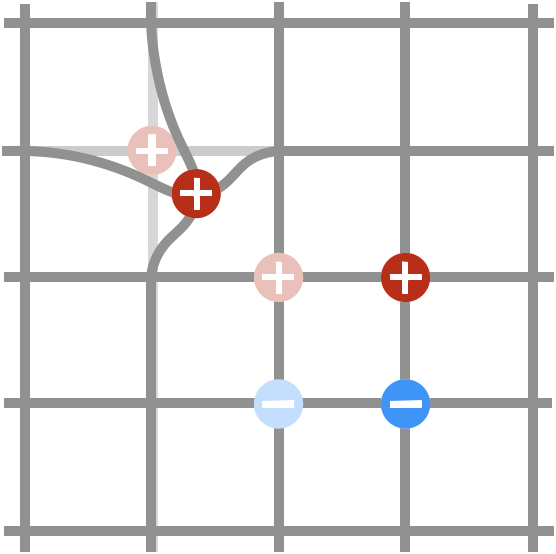
    Charges on a crystal lattice: an isolated charge can only move when the crystal is distorted, while neutral pairs move freely.
  • Dipole superfluid hydrodynamics. Part II.

    A. Jain, K. Jensen, R. Liu, E. Mefford

    Jan 2024 JHEP 2401.16385 INSPIRE

    In some quantum systems, not only the total charge but also its centre is conserved, so isolated charges cannot move: a hallmark of fractons, which can be realised with atoms in tilted optical lattices. At finite temperature such systems can form unusual superfluids. We develop the theory of how “s-wave” dipole superfluids flow, which requires a new way of deciding which effects matter most at long distances. We find ordinary sound waves alongside a dipole version of superfluid “second sound” that travels like spin waves in a magnet, and work out how these fluids respond to external probes.

  • Dipole superfluid hydrodynamics

    A. Jain, K. Jensen, R. Liu, E. Mefford

    Apr 2023 JHEP 2304.09852 INSPIRE

    Fractons, exotic excitations that cannot move on their own, can arise in systems that conserve not just charge but also its centre, the dipole moment. This is expected in two-dimensional elastic materials, vortices in superfluid helium and atoms in tilted optical lattices. We develop the theory of how they flow at finite temperature, showing that they only transport charge if the dipole symmetry is spontaneously broken, making them “dipole superfluids”. Their ripples are unusual: sideways disturbances fade far more slowly than in ordinary fluids, and sound behaves like spin waves in a magnet.

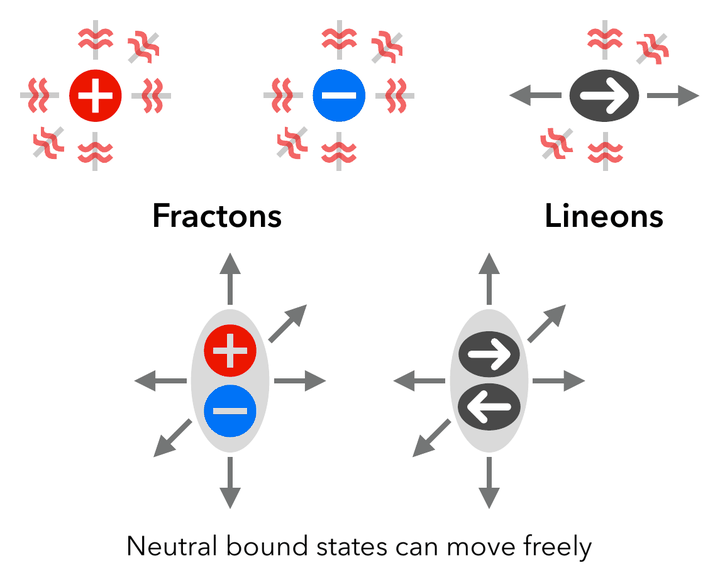
    Restricted mobility when the dipole moment is conserved: isolated charges (fractons) cannot move, dipoles (lineons) move only along a line, and neutral bound states move freely.
  • Fractons in curved space

    A. Jain, K. Jensen

    Nov 2021 SciPost 2111.03973 INSPIRE

    Fractons are exotic excitations that cannot move on their own, because the theories describing them conserve not only charge but also its centre, the dipole moment. These unusual symmetries make it unclear how to place such theories in curved space, a step needed to define their energy and momentum and, eventually, to describe how they flow. We show how to do this consistently for simple fracton field theories, and find hints of an anomaly: the gauge theory that naturally couples to dipoles cannot be put in curved space while keeping all its symmetries. The results extend to higher moments.

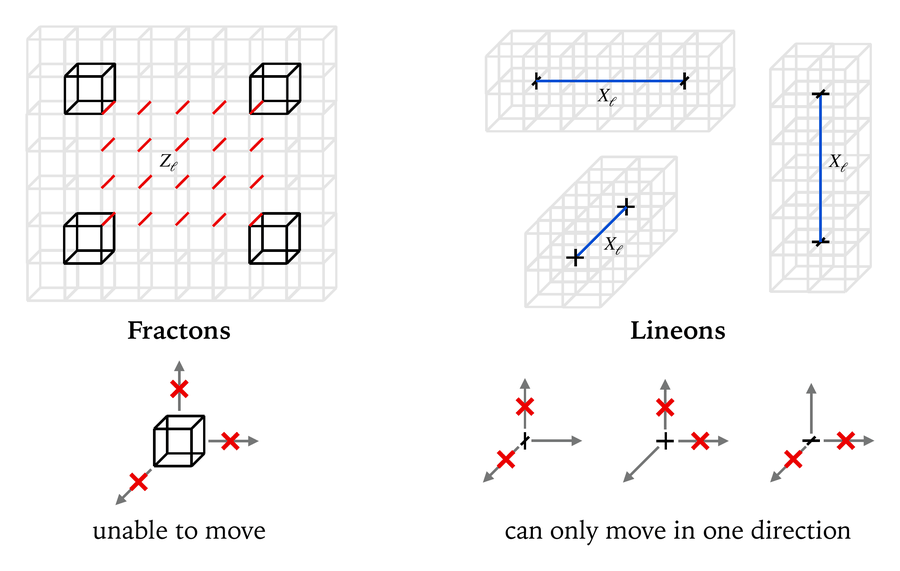
    The X-cube lattice model: fractons, created at the corners of a membrane, are unable to move; lineons, created at the ends of a straight line, can only move along one direction.

Talks

Fractons and dipole symmetries

Jain, Jensen 2021 Jain et al. 2023

  • École Polytechnique, France

    Slides

  • University of Cambridge, UK

    Slides

  • Coherence Correlations Complexity Seminar, University of Wrocław, Poland

    Recording Slides

  • Rencontres Théoriciennes, Institut Henri Poincaré, Sorbonne University, France

    Recording Slides