Akash Jain

Search

Non-relativistic and boost-agnostic hydrodynamics

Hydrodynamics of Galilean fluids from first principles, and effective theories that assume no boost symmetry at all.

Everyday fluids such as water and air move far slower than light and are described by non-relativistic hydrodynamics. Much of my early work built non-relativistic and Galilean hydrodynamics from first principles: equilibrium partition functions, entropy currents, the effects of anomalies, and a systematic way to obtain non-relativistic fluids from relativistic ones through null (light-cone) reduction.

Later, I developed effective field theories for non-relativistic hydrodynamics and, with Jay Armas, for hydrodynamics that assumes no boost symmetry at all. This treats relativistic fluids, Galilean fluids and systems with neither symmetry in one framework.
Papers

  • Effective field theory for hydrodynamics without boosts

    J. Armas, A. Jain

    Oct 2020 SciPost 2010.15782 INSPIRE

    Most theories of fluids assume that physics looks the same to an observer moving at constant speed, a symmetry called boost invariance. Many systems break it, such as fluids flowing through a medium, electrons in some quantum materials, or very cold liquid helium-3. We build the effective field theory of hydrodynamics without boost symmetry, including random fluctuations, and find 29 independent transport coefficients at first order. Sound then travels at different speeds with and against the flow. The framework treats relativistic, non-relativistic and exotic fluids alike.

  • Single-authored

    Effective field theory for non-relativistic hydrodynamics

    A. Jain

    Aug 2020 JHEP 2008.03994 INSPIRE

    Everyday fluids such as water and air move far slower than light and obey non-relativistic physics. A modern effective field theory of hydrodynamics, which also accounts for random thermal fluctuations, existed for relativistic fluids, but not for these ordinary ones. I construct it using a geometric trick: a non-relativistic fluid can be viewed as a relativistic one in a spacetime with one extra dimension, along a special lightlike direction. The relativistic tools then carry over, and I use them to work out how fluctuations of energy, momentum and density interact.

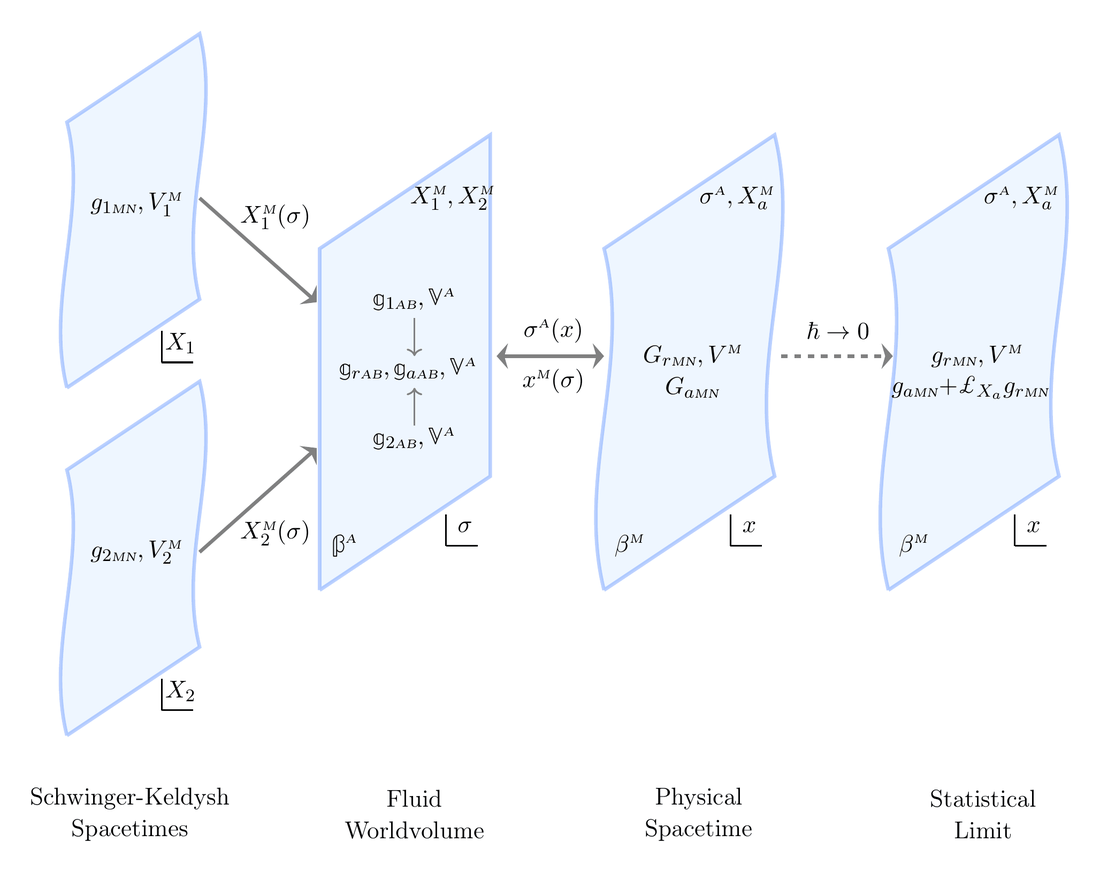
    Schematic of the effective field theory: two copies of spacetime are mapped onto a fluid worldvolume, and from there onto the physical spacetime.
  • Second order Galilean fluids and Stokes’ law

    N. Banerjee, S. Atul Bhatkar, A. Jain

    Nov 2017 PRD 1711.09076 INSPIRE

    Everyday fluids are described by the Navier–Stokes equations, which capture viscosity but are only the first step in an expansion in how rapidly the flow varies. We work out the next step, the second-order corrections for an uncharged non-relativistic fluid, using “null fluids”: a description of such fluids as relativistic ones in one extra dimension, which makes their symmetries easy to handle. The method yields an algorithm for any order. We then ask how the new terms affect Stokes’ law for the drag on a small sphere moving slowly through a fluid, and find which leave it unchanged.

  • First Order Galilean Superfluid Dynamics

    N. Banerjee, S. Dutta, A. Jain

    Dec 2016 PRD 1612.01550 INSPIRE

    Superfluids, first seen in liquid helium in 1938, flow without friction and form vortices when rotated. We work out the general theory of how non-relativistic superfluids flow and dissipate at first order in gradients, including effects that break mirror symmetry or come from quantum anomalies. To do so, we construct “null superfluids”: relativistic superfluids in one extra dimension that are exactly equivalent to non-relativistic ones, so that the powerful tools of relativistic hydrodynamics can be applied.

  • Single-authored

    Galilean Anomalies and Their Effect on Hydrodynamics

    A. Jain

    Sep 2015 PRD 1509.05777 INSPIRE

    Quantum anomalies are symmetries of a classical theory that are broken by quantum effects. In relativistic fluids, such as the quark-gluon plasma, they make currents flow along magnetic fields and rotation axes. I study anomalies in non-relativistic theories by viewing them as relativistic theories in one extra dimension, now also allowing for spin and the torsion of spacetime. As in the relativistic case, they only occur in even dimensions, and they leave Galilean boosts untouched. I also work out how they modify the flow of non-relativistic fluids.

  • Null Fluids - A New Viewpoint of Galilean Fluids

    N. Banerjee, S. Dutta, A. Jain

    Sep 2015 PRD 1509.04718 INSPIRE

    Non-relativistic physics can be seen as a corner of relativistic physics: the symmetries of everyday, slow-moving systems sit inside those of special relativity in one extra dimension. We use this to define “null fluids”, relativistic fluids in one higher dimension that are exactly equivalent to ordinary non-relativistic fluids, with the same symmetries, thermodynamics and equations to all orders. This makes their symmetries manifest and lets relativistic results carry over. We also use it to include quantum anomalies, which add new effects that break mirror symmetry.

  • Equilibrium partition function for nonrelativistic fluids

    N. Banerjee, S. Dutta, A. Jain

    May 2015 PRD 1505.05677 INSPIRE

    For relativistic fluids, the equilibrium behaviour in any external field follows from a single object, the equilibrium partition function, which strongly constrains its flow. We construct the analogous partition function for non-relativistic fluids, obtaining them from relativistic fluids in one extra dimension through a light-cone reduction. The resulting “null fluid” matches the non-relativistic fluid exactly, with the same symmetries, thermodynamics, equations and partition function to all orders. This short paper introduced null fluids, developed fully in our follow-up work.

  • Entropy current for non-relativistic fluid

    N. Banerjee, S. Dutta, A. Jain, D. Roychowdhury

    May 2014 JHEP 1405.5687 INSPIRE

    The second law of thermodynamics, that entropy never decreases, strongly constrains how fluids can dissipate energy. We apply it to non-relativistic charged fluids in electric and magnetic fields, including fluids whose microscopic physics breaks mirror symmetry, by obtaining them from relativistic fluids in one extra dimension. For ordinary fluids, it simply requires viscosity and the conductivities to be positive. For mirror-asymmetric fluids, the entropy current needs two extra terms, which the second law fixes exactly, and such effects survive only if the fluid is incompressible.

Talks

Non-relativistic Schwinger-Keldysh hydrodynamics

Jain 2020 Jain, Kovtun 2020 Armas, Jain 2020b

  • Non-Lorentzian Zoom Meeting, NORDITA Stockholm, Sweden (online)

    Conference talk Slides

Offshell framework of hydrodynamics

Jain 2016 Banerjee, Bhatkar, Jain 2017

  • Durham University, UK (HEP Student Seminar)

    Slides

Non-relativistic hydrodynamics and null reduction

Banerjee et al. 2014 Banerjee, Dutta, Jain 2015b Banerjee, Dutta, Jain 2015c Jain 2015

  • International Centre for Theoretical Physics, Italy

    Slides

  • LACES 2015 Workshop, Galileo Galilei Institute for Theoretical Physics, Italy

    Blackboard talk

  • Durham University, UK (HEP Student Seminar)

    Slides

  • STRINGS 2015 Conference, ICTS Bangalore, India

    Poster

  • Young Theorists Forum Conference, Durham University, UK

    Conference talk Slides

  • Inter-IISER and NISER Physics Meet, IISER Pune, India

    Conference talk Poster